numbers and benchmarks
What does a classroom holiday party actually cost per child once you add everything up?
Break the party budget into its real line items: food, supplies, decorations, craft materials and the teacher gift, then work backward to a per family ask you can defend.
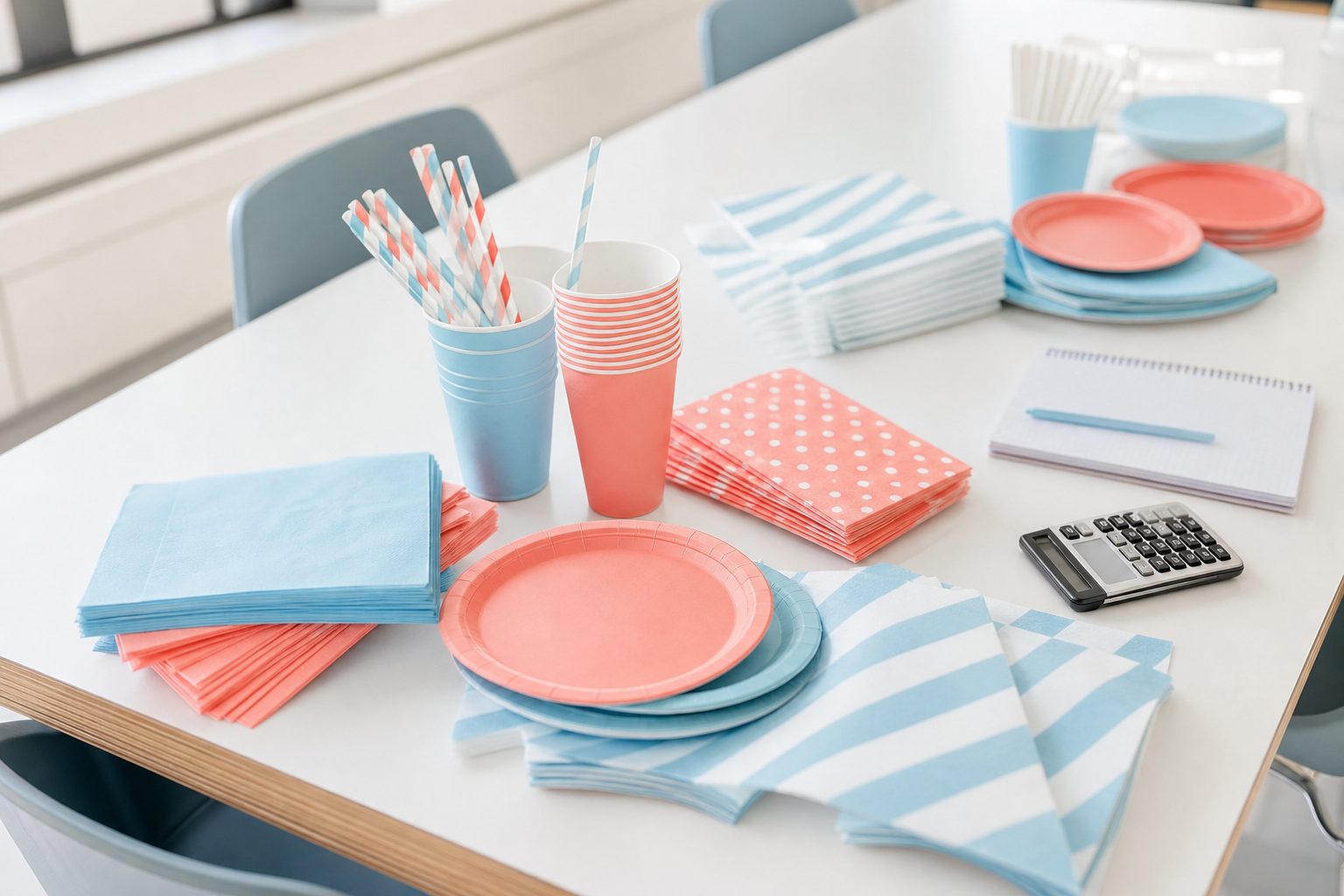
For a class of 24 students, a one hour holiday party built the ordinary way lands somewhere around $6 to $9 per child once you total food, drinks, plates and napkins, one craft, and a small reusable decoration budget. Add a pooled teacher gift and the number roughly doubles. That is the honest answer, and the wide range is not vagueness: it is the difference between a party where four families bring the food and one where you buy everything.
The per child figure is also not the number you ask for. Families do not pay per child, they pay per family, and not all of them pay. Those two adjustments are where most room parent budgets quietly fail.
What follows is the arithmetic, built line by line, with every assumption named so you can swap in your own class size and your own store.
Building the line item list before naming a number
The most common mistake is starting at the ask. Someone says "$10 sounds fine" and then the plan gets bent to fit $10, which usually means the last item on the list quietly disappears and one parent covers it out of pocket.
Write the list first. For a standard classroom party the categories are:
- Food and drink
- Serving goods: plates, cups, napkins, forks, a tablecloth
- One craft or activity, per student
- Decorations, split into reusable and consumable
- Optional: a teacher gift, a class gift, or a small favor per child
Then decide for each line whether it is purchased with collected money or donated in kind by a family claiming a slot. That single distinction changes the total more than any price shopping will. A party where six families each bring one food item may need almost no cash at all.
Set your class size and party length before pricing. Everything below assumes 24 students and a 45 to 60 minute party in the classroom.
Keep reading: What is it really like to run volunteer slots for a school field trip from start to finish?
Food costs and the allergy safe alternatives premium
Kids at a school party eat less than you expect, because they are excited and the clock is short. Plan roughly two small items and one drink per child.
| Item | Assumption | Estimated cost |
|---|---|---|
| Cookies or cupcakes | 2 dozen plus, packaged and labeled | $18 |
| Fruit or veggie tray | 1 large tray | $16 |
| Pretzels or crackers | 2 large bags | $8 |
| Juice boxes or water | 24 count plus spares | $12 |
| Allergy safe alternative | Dedicated packaged treat for 1 to 3 students | $10 |
Food subtotal at these assumptions: about $64, or $2.67 per child.
The allergy line deserves its own note. Specialty items, a gluten free or nut free or dairy free packaged treat, commonly cost two to three times the per serving price of the standard version, and you often have to buy a full package for one child. Budget it as a flat $8 to $15 line rather than a per child rate, and do not treat it as optional. A child sitting with nothing is the failure mode this line prevents.
If your school requires commercially packaged, labeled food, and many do, remove homemade from the plan entirely. It also removes a whole category of anxious label reading on party morning.
Craft and supply costs per student
Crafts are where budgets inflate because craft kits are priced per child and marketed hard.
Three tiers, for 24 students:
- Paper based, bulk supplies: construction paper, glue sticks, markers you already have, one bag of pom poms. Roughly $12 to $20 total, or under $1 per child.
- Pre cut foam or wooden kits: commonly $1.50 to $3 per child, so $36 to $72 for the class.
- Ornament or keepsake kits: $3 to $5 per child, $72 to $120.
Serving goods sit alongside this. Paper plates, cups, napkins and forks for 24 with spares runs about $14 to $22 if you buy plain rather than themed. Themed party goods often cost double for the same paper.
Assume the middle craft tier at $2 per child ($48) and plain serving goods at $18. Supplies subtotal: $66, or $2.75 per child.
Keep reading: How do I actually collect twenty five dollars from thirty families without chasing people for weeks?
Decorations you buy once and reuse
Decoration is the line to underspend on deliberately. A classroom is already visually loud, the party is under an hour, and children do not notice a coordinated color story.
Split the category:
- Reusable: a plastic or fabric tablecloth, a felt banner, a set of bins for transport. Buy once, store in the classroom closet or hand to the next room parent. Call it $25, amortized across the school year's three parties, so about $8 per party.
- Consumable: balloons, streamers, paper garland. $10 to $15 per party, and genuinely skippable.
Assume $8 amortized plus $10 consumable: $18 per party, or $0.75 per child.
One caution: check on balloons. Latex balloons are a documented choking hazard for young children and a real allergy issue for some, and many elementary buildings prohibit them outright. Mylar or no balloons at all is the safe default.
Whether the teacher gift belongs in the same ask
Financially, this is the biggest single decision in the whole budget. A pooled teacher gift at $10 per family across 24 families is $240, nearly four times the entire food line.
Keep it separate. Three reasons:
- The two asks have different opt out rates. A family may skip the gift and still contribute to the party, or the reverse. Bundling forces an all or nothing answer and loses both.
- Rules apply differently. Many districts and states cap the value of gifts to public employees, and a pooled class gift can exceed a cap that no individual contribution comes near. Confirm the number with the office before you set a target.
- The accounting is cleaner. Party money buys party things and is spent to zero. Gift money is a pass through. Mixing them makes the end of year reconciliation harder than it needs to be.
Practically: two separate signups, sent a week apart, with different wording. The party ask is logistics. The gift ask is voluntary and should say so twice.
See how RoomParentHub handles this for school parent groups and class fundraising
Setting the per family number with a participation assumption
Now the arithmetic that matters. Total the party lines:
| Category | Total | Per child (24 students) |
|---|---|---|
| Food and drink | $64 | $2.67 |
| Craft and serving goods | $66 | $2.75 |
| Decorations | $18 | $0.75 |
| Party total | $148 | $6.17 |
Now convert to a family ask. Assume 22 households for 24 students, since some classes have siblings or twins. If every household paid, the ask would be $148 divided by 22, about $6.75.
But every household will not pay. Use a participation assumption and state it as an assumption, because it is one. If you expect 70 percent to contribute, that is roughly 15 paying households. The ask becomes $148 divided by 15, about $9.87. Round to $10.
The general form, worth keeping:
Ask per family = total budget divided by (households multiplied by expected participation rate)
Your own participation rate is knowable after one cycle. Track it. A class that came in at 60 percent in October will not hit 90 percent in December because you asked more warmly. If you have no history, 65 to 70 percent is a defensible planning figure for a first ask, and you should say in the message that partial contributions are welcome.
Then cut the ask where you can. If four families claim in kind food slots, the food line drops out of the cash budget entirely and the $148 becomes $84, which at 15 paying households is under $6 per family. In kind slots are the cheapest lever you have.
What to do when the drive comes in under target
It will happen, usually at about 60 percent of goal three days out. Do not send a guilt message. Cut in a fixed order instead, and decide the order before you need it.
- Consumable decorations. Gone first, always. Nobody will notice.
- Downgrade the craft tier. Kits become bulk paper. This is the single largest recoverable line.
- Convert food lines to in kind slots. Post three specific slots to the class: one fruit tray, one bag of pretzels, one case of water. Naming the exact item gets them filled.
- Plain serving goods instead of themed. Often halves that line.
- Shorten the food list. Two items and a drink is a party. Five items is a buffet.
What never gets cut: the allergy safe alternative, and any child's participation. Those are not budget lines, they are the point.
If you still come up short, cover the gap from a prior surplus if your group holds one, and write down what happened. A note that says "October came in at 58 percent, we cut the craft to paper and it was fine" is worth more to next year's room parent than any spreadsheet.
Turning the number into an ask that gets answered
The budget is the easy half. The hard half is getting 15 households to actually respond, tracking who covered the fruit tray, keeping contribution amounts private, and having a clean total when someone asks in the spring.
RoomParentHub handles that side: one classroom list showing both the dollar ask and the in kind slots, reminders that go only to families who have not answered yet, contributions collected and totaled as they arrive so you can see at any moment whether you are at 60 percent or 90, and a teacher facing summary of what is coming and who is bringing it. Build the line items with the arithmetic above, put the list up, and let the tracking take care of itself.